AI Agent Memory Architecture: The Three Layers Production Systems Need
AI agents need more than a vector database. Production systems require three distinct memory layers — episodic, semantic, and state. Here's what each layer does and why it matters.
TL;DR: Production AI agents need three distinct memory layers — episodic (conversation/interaction history), semantic (domain knowledge and facts), and state (live operational context) — unified under a single coherent substrate. Most teams only build one layer (usually a vector database for retrieval), which is why agents fail in production: they spin on stale, fragmented context instead of compounding intelligence over time.
In developing the theoretical foundations for Context Lake, I spent considerable time analyzing why production AI agents fail. The pattern was remarkably consistent: teams build sophisticated agent logic on top of memory systems that were never designed for agent workloads.
Ask most AI teams how they handle agent memory and you'll hear one of two answers: "We use a vector database" or "We're figuring it out." Neither is sufficient. Vector databases solve retrieval. They don't solve memory.
What production agents actually require is a memory architecture with three distinct layers — episodic, semantic, and state — unified under a single coherent substrate. Most teams are building with only one. The consequences are predictable: agents spin their wheels on stale, fragmented context instead of compounding intelligence over time. Memory architecture is, in fact, the hardest part of context engineering — the discipline of designing what information an agent sees, when, and in what format.
Why Memory Architecture Matters for Agents
Human analysts can tolerate latency. They cross-reference dashboards, notice inconsistencies, adjust their mental model. An analyst looking at yesterday's data can still make reasonable decisions because they understand the data is stale.
Agents cannot do this. They operate at millisecond decision cycles, often making irreversible choices — approving transactions, triggering workflows, updating customer records. When an agent acts on stale or inconsistent data, it doesn't know it's wrong. It proceeds with confidence.
In my formal analysis of decision coherence, I established what I call the Decision Coherence Law: agents taking irreversible actions whose effects interact can only operate constructively when interacting decisions are evaluated against a coherent representation of reality at the moment they are made.
This is not an optimization target. It is a fundamental requirement. Agents making concurrent, irreversible decisions over shared resources need different infrastructure than systems designed for human analysis. Memory architecture is how you achieve that coherence.
The Three Memory Layers
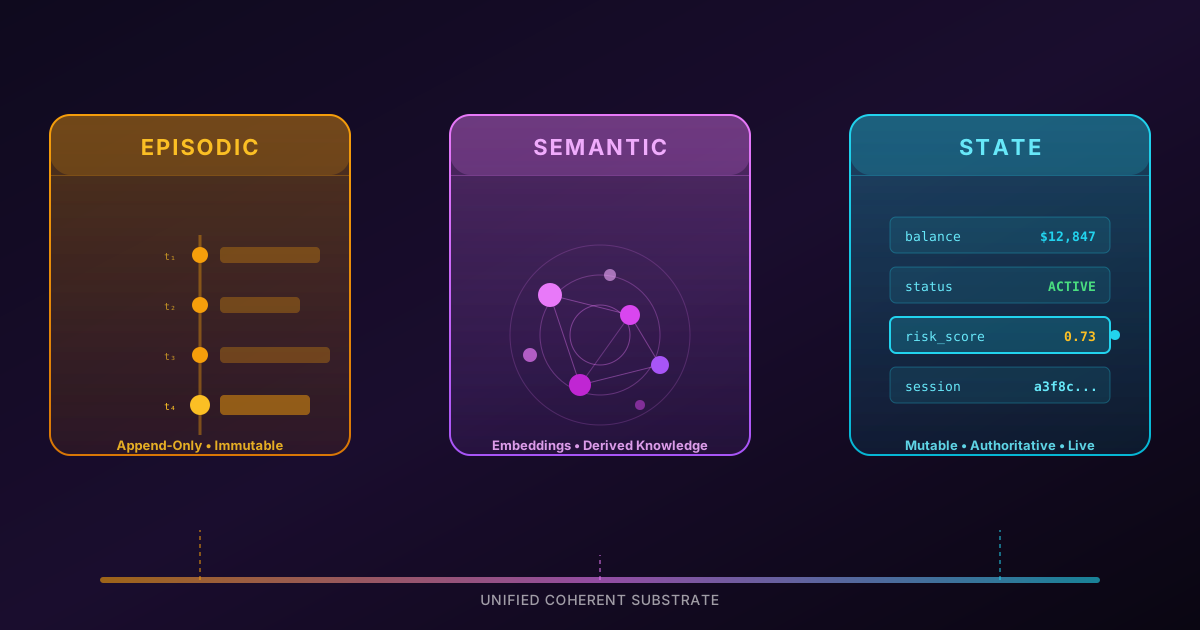
Production agent memory is not one thing — it is three distinct layers with different characteristics, lifecycles, and access patterns:
Layer
Mutability
Key Property
Primary Use
Episodic
Append-only
Temporal ordering
Raw events, audit trail
Semantic
Governed
Shared interpretations
Embeddings, learned patterns
State
Mutable
Authoritative
Current conditions
Episodic Memory
Episodic memory stores immutable observed experiences — every interaction, event, and piece of raw data the agent encounters, recorded as-is and timestamped.
This layer enables time-travel queries: the ability to ask "what did the agent know at the moment it made this decision?" When a fraud detection agent misses a suspicious transaction, you need to reconstruct exactly what data it saw. This is essential for debugging, auditing, and compliance.
The common mistake is treating episodic memory as optional logging. It is the foundation for reproducibility and temporal reasoning.
Semantic Memory
Semantic memory stores mutable shared interpretations — derived knowledge, aggregations, and learned patterns that agents use for reasoning. Unlike episodic memory, semantic memory evolves as understanding improves.
This is where agents store what they have learned: customer preferences, risk scores, behavioral patterns, domain knowledge. It is typically what teams think of when they reach for a vector database.
The problem is that semantic memory alone is not sufficient. Vector databases optimize for retrieval similarity, not consistency guarantees. When Agent A updates a customer's risk profile while Agent B is mid-decision, you need transactional semantics — not just similarity search. Vector search is a retrieval pattern, not a memory architecture.
State Memory
State memory stores current operative conditions — the live, mutable data that represents "right now." Account balances, inventory levels, session states, active workflows.
This is where decisions become actions. When an agent approves a transaction, that approval must be immediately visible to every other agent that might act on the same account. Data freshness is a correctness requirement, not a performance optimization.
The common mistake is relying on caches or replicas for state. Any replication lag creates a window where agents see different versions of reality — and that window is where coordination failures occur.
Summary: The Three Layers
Production AI agents require three distinct memory layers, each serving a different purpose:
Episodic memory stores immutable observed experiences — the raw events, interactions, and data the agent encounters, timestamped and preserved for temporal reasoning and audit.
Semantic memory stores mutable shared interpretations — derived knowledge, embeddings, and learned patterns that agents use for reasoning and retrieval.
State memory stores current operative conditions — the live, authoritative data that represents "right now" and where decisions become actions.
Most teams build with only one layer, typically semantic (a vector database). The result: agents that cannot audit their past decisions, cannot share learned context, or cannot see consistent current state. Understanding these three layers is the starting point for building memory infrastructure that agents can actually trust.
Frequently Asked Questions
AI AgentsMemory ArchitectureContext LakeAgent InfrastructureDecision Coherence