Tacnode™
Back to Blog
Architecture

Meet the 14 Lies Your Data Pipeline Tells

Pipelies is a field guide to the ways a stitched-together data stack hands decisions numbers that are no longer true: seven suspects, fourteen scenarios you can step through, and an interrogation for your own pipeline.

Alex Kimball
Alex Kimball
Product Marketing
5 min read
A glass pipeline on a dark background, broken in the middle with flames coming through the gap

TL;DR: Pipelies is a field guide to the ways a stitched-together data stack hands decisions numbers that are no longer true. Seven suspects, fourteen lies, each one a scenario you can step through, plus a six-question interrogation for your own pipeline. See the lineup.
Job status: succeeded. 412 rows never made it through.

Replica healthy. It's several seconds behind, because it's lunchtime.

Risk score: low. Computed at 2 a.m. Someone else took over the account at noon.

Each of those statements came from a system working as designed, and each is accurate about itself. None of them tells the decision reading the number whether that number is still true.

Pipelies is our field guide to those statements. We built it so you can watch one happen.

Seven Suspects, Fourteen Lies

Each lie gets a page that opens with the same three facts: what the system says, what's true, and what it cost. Then you step through the scenario moment by moment, with what the decision saw next to what was actually true.

SuspectIts alibiLies on file
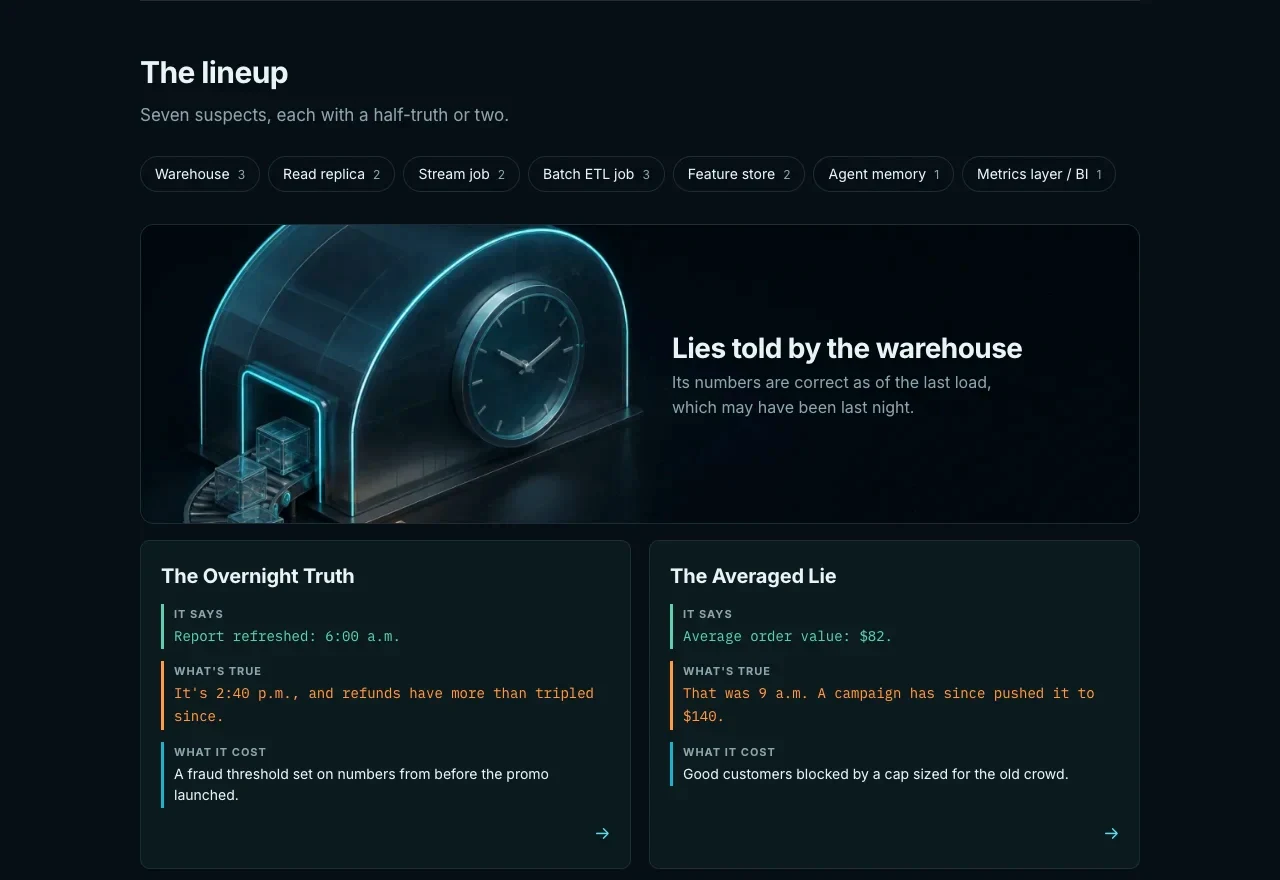
WarehouseCorrect as of the last load, which may have been last nightThe Overnight Truth, The Averaged Lie, The Next-Day Alert
Read replicaUsually a moment behind the primary, and further behind when you're busyThe Vanishing Order, The Peak-Hour Lag
Stream jobKeeps the running totals, and at the busiest moments they trail the eventsThe Scattered Balance, The Crowded Total
Batch ETL jobMarks the run green even when some of the rows didn't make itThe Silent Skip, The Late Arrival, The Linked Accounts
Feature storeHands your models features from the last scheduled runThe Frozen Score, The Stale Segment
Agent memoryHolds whatever was true when the agent last checkedThe Agent's Alibi
Metrics layer / BIAsk two dashboards for revenue and you may get two numbersThe Two Truths
The Pipelies lineup page: filters for seven suspects above a banner reading Lies told by the warehouse, with cards listing what each lie says, what's true and what it cost

Watch One Happen

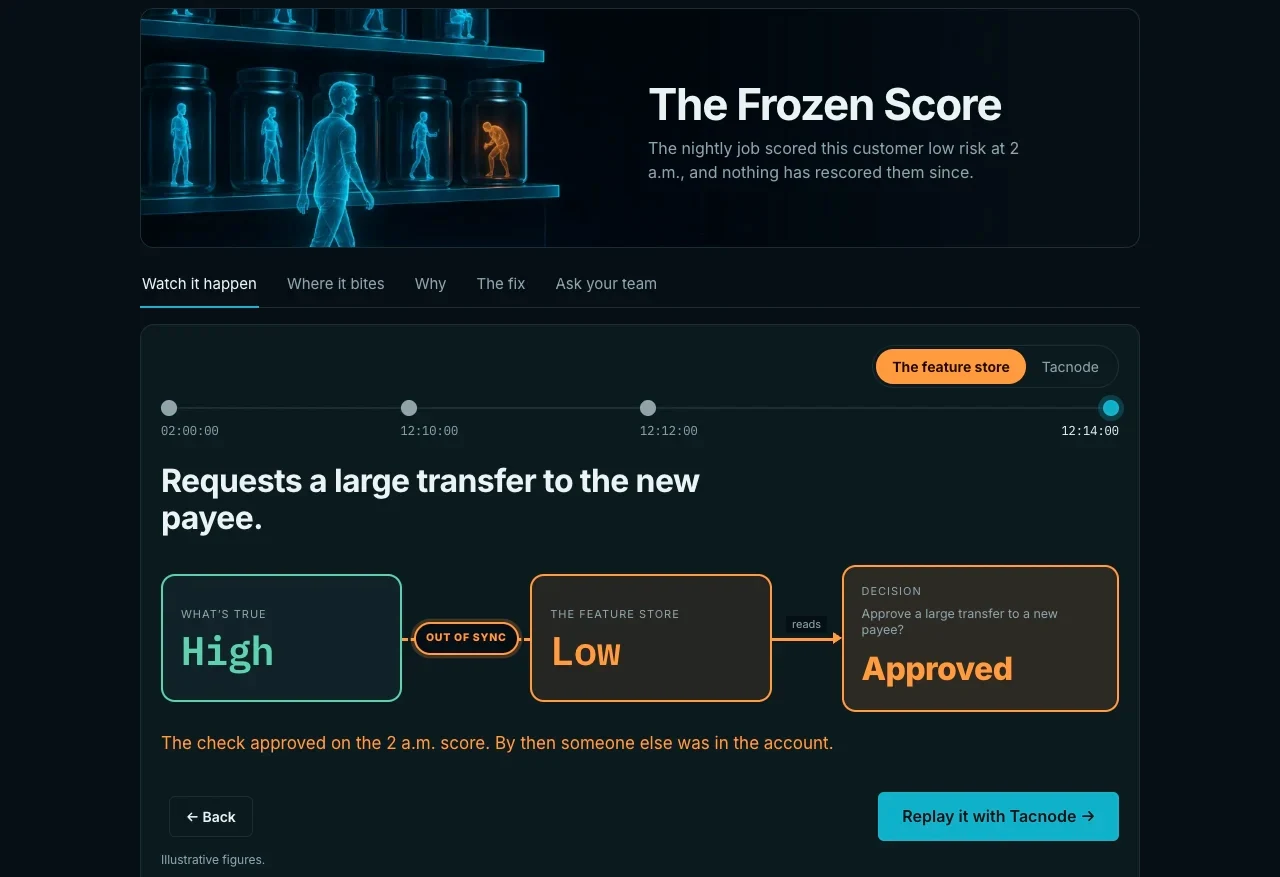
Each scenario plays out on a timeline. Here's the last moment of The Frozen Score: the customer's risk is really high, the feature store still says low, and the transfer check approves the request.

The Frozen Score scenario at 12:14: What's true shows High, the feature store shows Low, marked out of sync, and the decision shows Approved

Then Replay It With Tacnode

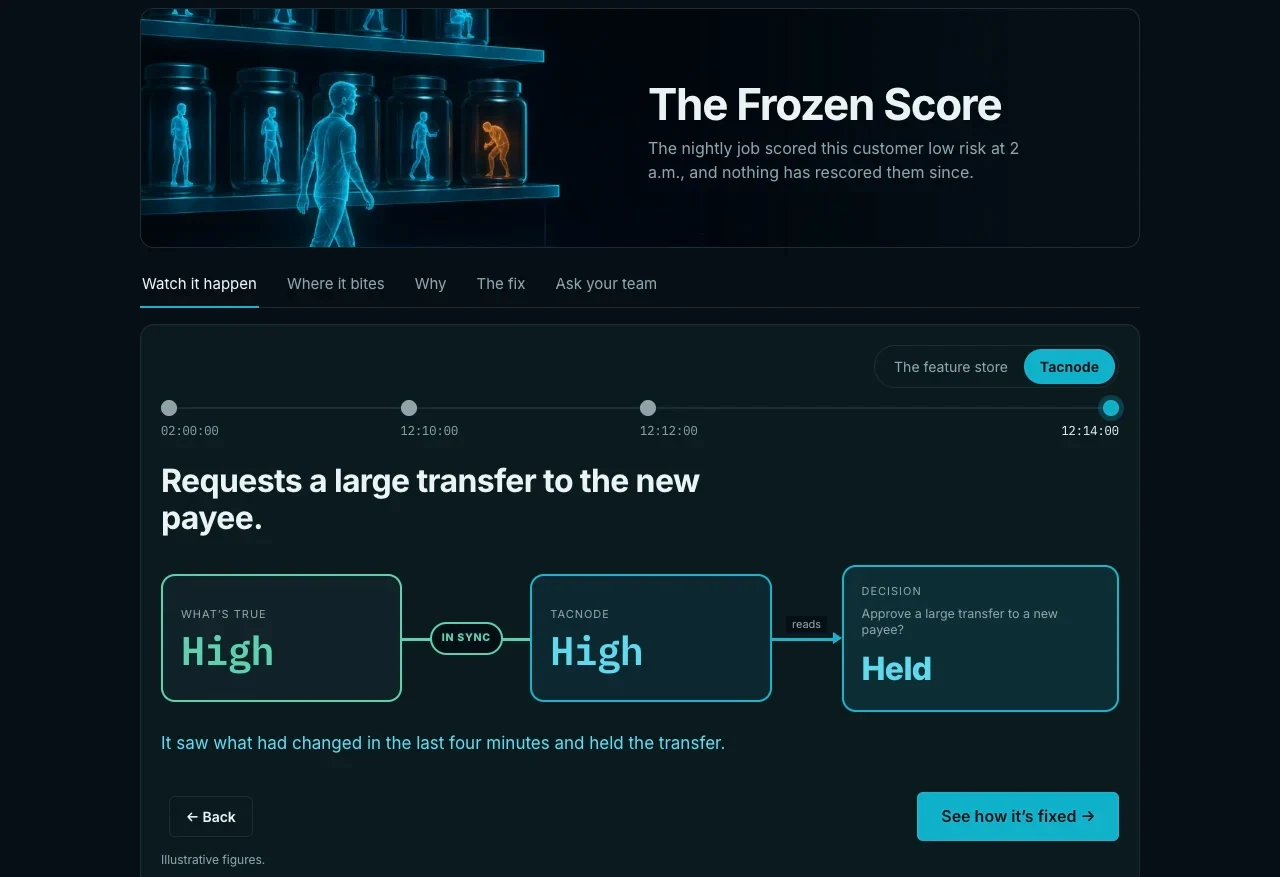
One click runs the same moments again with Tacnode in place of the stale read. The events don't change. The check sees what happened in the last four minutes, and the transfer is held.

The Frozen Score scenario replayed with Tacnode at 12:14: What's true shows High, Tacnode shows High, marked in sync, and the decision shows Held

Behind Each Lie

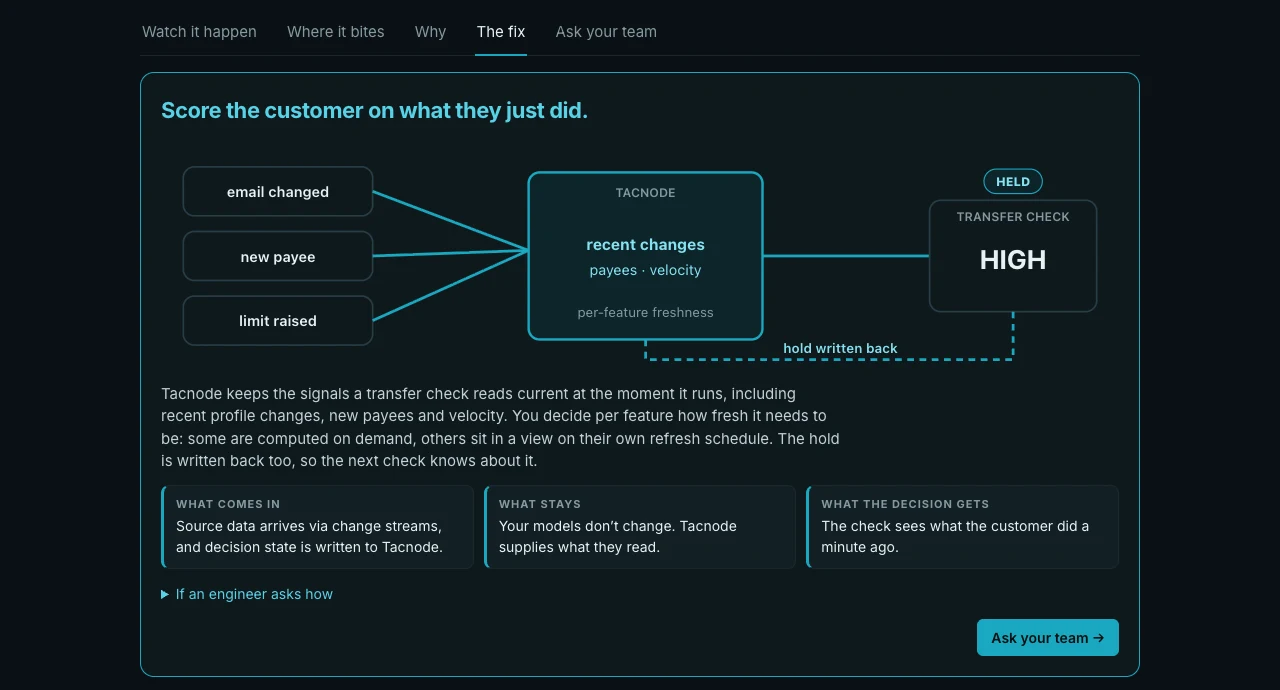
Four more tabs sit behind every scenario: where the lie shows up in other workflows, why the system gets it wrong, the fix, and the questions to put to your team. The fix tab draws what comes in, what stays where it is, and what the decision gets.

The fix tab for The Frozen Score: email changes, new payees and raised limits flow into Tacnode, the transfer check reads a high score and holds, and the hold is written back

Three to Play First

The Frozen Score. At 2 a.m. the nightly job scores a customer low risk. At 12:10 someone changes the account's email and phone number. At 12:12 they add a new payee and raise the transfer limit. At 12:14 they request a large transfer to that payee. The check reads the 2 a.m. score and approves it.

The Scattered Balance. At the open, a customer with $5,000 buys $3,000 of event contracts. Two seconds later they place a $4,000 crypto order. The fill is on Kafka and the stream job hasn't folded it in yet, so the order check sees $5,000 of buying power. The customer had $2,000.

The Agent's Alibi. Two agents read the same $5,000 budget a couple of seconds apart. Agent A commits $4,000. Agent B, acting on what it read, commits $3,500. The budget is $2,500 over, and there was nobody between the read and the action to notice.

Why Nothing Looks Broken

A decision reading a stale number gets a fast, successful response. There's no error, no timeout and no alert, because nothing failed.

Of the fourteen lies, nine are numbers that were true earlier, three are missing something that should be there, and two are systems that disagree with each other. Outdated, incomplete and inconsistent are the three ways a context gap shows up.

None of these systems is bad at its job. A warehouse answers questions about closed periods very well. The trouble starts with the copying: each hop between where a fact lands and where a decision reads it adds its own delay, and reports only on itself.

So keep your streams. Lose the pipelines that copy them into caches.

Interrogate Your Own Pipeline

Six questions: how often the data your decisions read gets refreshed, how many systems one decision reads from, what happens when two of them disagree, how you learn a job dropped data, whether automated actions read that data, and what acting on a stale number costs you.

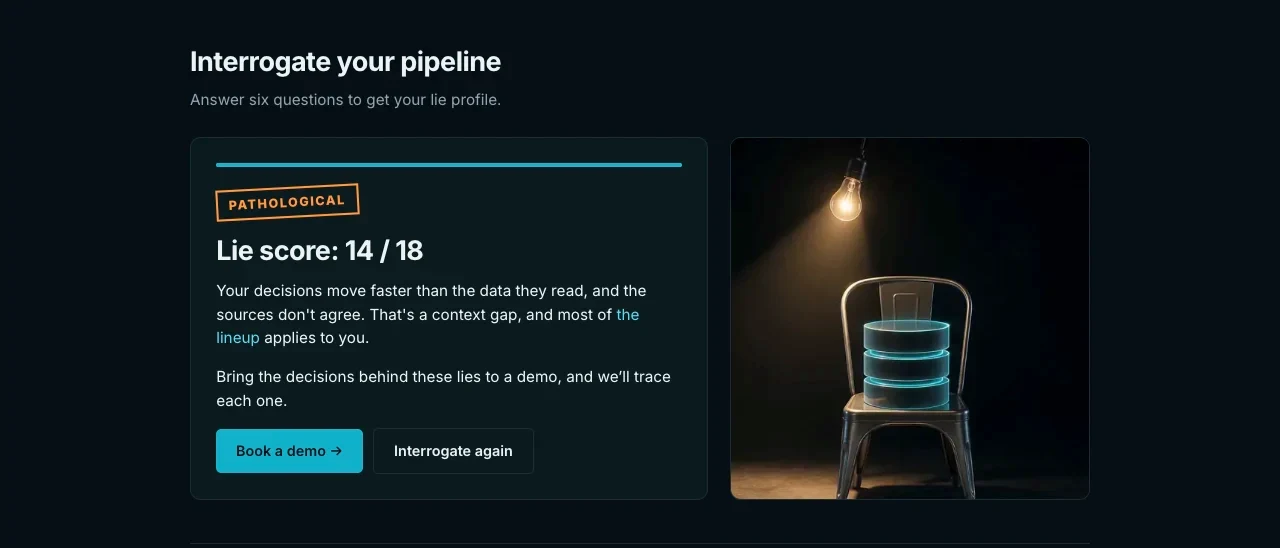
You get a lie score out of 18 and a profile: Mostly Honest, Chronic Staler, Two-Faced or Pathological. Take the interrogation.

A Pipelies quiz result stamped Pathological with a lie score of 14 out of 18, beside artwork of a database on a chair under a bare light bulb

What We Do About It

Tacnode keeps the numbers your checks depend on, such as exposure, buying power and limits across accounts, consistent and current at peak, without copying them through pipelines into caches. Source data arrives from the systems you already run. A decision reads its context and produces a verdict, a hold or an action, and that output is written back as context for the next decision.

Every lie page shows what would change for that decision and what stays where it is. If one sounds familiar, bring that decision to a demo, and we'll trace what it reads and how old that data is when it runs.

Data PipelinesData FreshnessContext EngineeringDecision Systems
Alex Kimball

Written by Alex Kimball

Former Cockroach Labs. Tells stories about infrastructure that actually make sense.

Fresh Context Newsletter

The argument behind the posts — what breaks when AI acts on stale data, from the team building the Context Lake. About twice a month.

Subscribe on LinkedIn

Ready to see Tacnode Context Lake™ in action?

Book a demo and discover how Tacnode can power your AI-native applications.

Book a Demo