What Is Data Observability? The Complete Guide [2026]
Data observability monitors data health across your pipelines. Learn what data observability means, how it differs from data quality, the pillars of data observability, and why reactive monitoring isn't enough.
TL;DR: Data observability is the ability to understand the health of data as it flows through your systems — monitoring freshness, volume, schema, distribution, and lineage. It's distinct from data quality (observability is the capability to see problems; quality is whether the data is actually good). Most observability tools are reactive — they detect issues after bad data has already propagated. The better model: proactive enforcement at ingestion that prevents bad data from entering your platform.
Data observability is the ability to understand the health of data as it flows through your systems. It gives data teams visibility into data pipelines, data quality issues, and data reliability — answering: "Is this data fresh? Is it complete? Can downstream processes trust it?"
The concept emerged as data ecosystems grew complex. Modern data stacks include dozens of data sources, multiple transformation layers, cloud data warehouses, and countless consumers. In these complex data environments, understanding what went wrong — and where — requires more than checking if a job succeeded.
Data observability tools have become essential for data engineers managing distributed data architectures. Gartner recognizes data observability as a critical capability for enterprise data teams. But here's the uncomfortable question most data observability platforms don't address: What if you could prevent data issues instead of just detecting them?
What Is Data Observability?
Data observability means monitoring and understanding data health across the entire data lifecycle. Unlike traditional monitoring that checks whether jobs run, data observability examines the data itself — its freshness, accuracy, completeness, and consistency.
A data pipeline can complete successfully every night while producing wrong data. Upstream sources might send missing values. Schema changes could introduce data anomalies. Or the data could simply be stale — technically correct but hours out of date.
Data observability solutions detect these problems by continuously monitoring key metrics across your data flows. When data quality issues arise, observability tools alert data teams, enable root cause analysis, and help resolve data incidents before they impact downstream processes.
The core premise: You can't fix what you can't see. Data observability makes the invisible visible — turning your data infrastructure from a black box into a glass box.
The Five Pillars of Data Observability
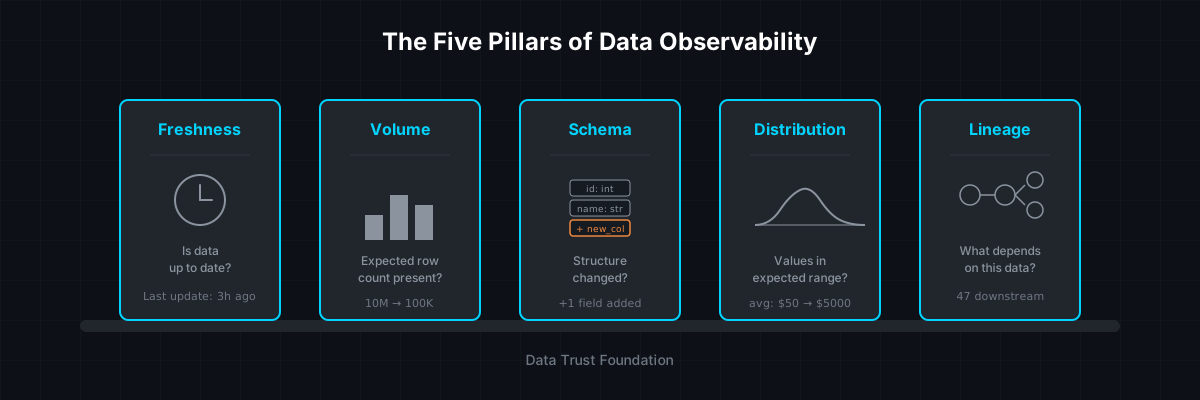
The pillars of data observability provide a framework for understanding what to monitor. These key metrics collectively determine whether data is trustworthy for data analysis and business intelligence tools:
1. Freshness — Is the data up to date? Data freshness measures how recently data was updated. Stale data is often worse than missing data because it silently produces wrong answers. For time-sensitive applications like fraud detection or real-time personalization, freshness is measured in seconds or minutes, not hours.
2. Volume — Is the expected amount of data present? Sudden drops or spikes in data volume often indicate problems in underlying data sources. A data pipeline that usually processes 10 million records but suddenly sees only 100,000 likely has an upstream issue.
3. Schema — Has the data structure changed? Schema changes in source systems frequently break data pipelines. Data observability platforms detect when fields are added, removed, or change type — ideally before those changes impact downstream data tables.
4. Distribution — Are data values within expected ranges? Data profiling establishes baseline distributions for critical datasets. When data values suddenly shift — a price field averaging $50 suddenly averages $5,000 — anomaly detection flags the change.
5. Lineage — Where did this data come from, and where does it go? Data lineage maps relationships between data assets, showing how data flows from sources through transformations to consumption. When data issues occur, lineage enables impact analysis — understanding exactly which reports, models, and systems are affected.
Pillar
Question Answered
Example Detection
Freshness
Is the data current?
Orders table hasn't updated in 3 hours
Volume
Is all the data present?
Yesterday's batch had 50% fewer records
Schema
Has the structure changed?
New 'discount_code' field appeared
Distribution
Are values reasonable?
Average order value jumped 400%
Lineage
What depends on this?
12 dashboards and 3 ML models affected
Data Observability vs Data Quality: What's the Difference?
Data observability vs data quality — they're related but distinct:
Data quality describes the characteristics that make data fit for use: accuracy, completeness, consistency, timeliness, validity. High quality data meets consumer needs. Poor data quality means errors, gaps, or inconsistencies that make data unreliable.
Data observability is the capability to detect and diagnose data quality issues. It's the instrumentation that gives you visibility into data health. You can have observability without having high quality data — observability just means you can see the problems.
The relationship: data observability enables you to ensure data quality. Without observability, poor data quality goes undetected until something breaks — a dashboard shows wrong numbers, an ML model makes bad predictions, a customer complains.
Many organizations invest in data quality metrics without the observability to detect quality degradation. The result: data quality issues fester for days before anyone notices. Robust data observability catches these early, enabling data teams to resolve data quality issues before they impact downstream processes.
In short: data quality is the destination; data observability is how you know whether you're getting there.
Data Observability Tools and Platforms
The data observability market has expanded rapidly. The major categories:
Dedicated Data Observability Platforms — Purpose-built tools like Monte Carlo, Bigeye, and Acceldata focus exclusively on data observability. These data observability tools offer automated monitoring across data warehouses and data lakes, ML-powered anomaly detection, data lineage and impact analysis, incident management, and integration with modern data stack components.
Embedded Observability — Some cloud data warehouses and data pipeline tools include native observability. Databricks, Snowflake, and dbt Cloud offer built-in monitoring, though often less comprehensive than dedicated solutions.
Open Source — Tools like Great Expectations and Elementary provide data testing and monitoring for teams building custom data observability solutions.
When evaluating data observability platforms: How quickly do they detect anomalies? How accurately do they identify root causes? How well do they integrate with your data infrastructure? And critically — do they just tell you about problems, or help prevent them?
Data Pipeline Observability: Where Problems Hide
Data pipeline observability monitors data as it flows through transformation and processing. This is where many data issues originate — and where they're hardest to detect.
Modern data pipelines are complex. Data flows from operational systems through ingestion, lands in staging, gets transformed by dbt or Spark, and arrives in serving layers. At each stage, things go wrong:
Ingestion failures: Data sources change without notice, sending malformed or missing data
Transformation bugs: Logic errors produce incorrect results that look plausible
Schema drift: Upstream changes propagate through pipelines, breaking downstream processes
Resource constraints: Jobs complete but skip records due to memory or timeout issues
Timing issues: Dependencies run out of order, producing inconsistent results
Data pipeline observability addresses these challenges through automated monitoring at each pipeline stage, data testing that validates assumptions about incoming data, lineage tracking that shows data flows end-to-end, and alerting that catches issues before they propagate.
The goal is troubleshooting data workflows before they become data incidents. When data engineers can see exactly where a pipeline failed and why, mean time to resolution drops dramatically.
Why Data Observability Is Important for Data Teams
Data observability has become essential:
Distributed data architectures — Data mesh and decentralized ownership mean no single team sees the whole picture. Data observability provides unified visibility across distributed data ecosystems.
Scale and complexity — Enterprise data environments include hundreds of data sources, thousands of data tables, countless data flows. Manual monitoring is impossible; automated observability is required.
Trust in data — Data scientists and analysts rely on self-service access to data assets. Without observability, they can't know if data is reliable. Observability enables accurate data consumption.
Machine learning models — ML models are sensitive to data quality issues. Bad training data produces bad models. Stale or incomplete features produce unreliable predictions.
Regulatory requirements — Data governance and compliance require demonstrating that critical datasets are accurate and properly managed. Data observability provides the audit trail.
Cost of data downtime — When data breaks, everything downstream breaks: dashboards, reports, ML predictions, business decisions. The financial operational cost of data downtime can reach millions per incident.
Data observability empowers data teams to maintain data integrity at scale, catch data errors early, and build reliable data that the business can trust.
The Problem with Reactive Observability
Here's what most data observability solutions get wrong: they're fundamentally reactive.
Traditional observability works like this: data flows through pipelines, tools monitor key metrics, and when something looks wrong — freshness threshold breached, distribution shifted, volume dropped — an alert fires. Data teams investigate, perform root cause analysis, fix the issue.
This is valuable. Far better than not knowing. But notice what's missing: by the time you detect the issue, it already happened.
Bad data already landed in your data warehouse. Reports already consumed it. ML models already made predictions on it. Decisions already used those predictions. The data incident occurred — observability just told you faster.
A concrete example: A data source starts sending missing values at 2:00 AM. Your data observability platform detects the anomaly at 2:15 AM. Alert fires. Engineer confirms by 3:00 AM. Fix deployed by 4:00 AM.
Sounds like success — under two hours. But during those two hours, bad data flowed through your entire data ecosystem. The data lineage shows 47 downstream data tables affected, feeding 12 dashboards and 3 ML models.
Observability found the problem. But the damage was already done.
From Detection to Prevention: A Better Model
What if instead of detecting data quality issues after they occur, you could prevent them at the point of entry?
This requires shifting from reactive observability to proactive enforcement — catching bad data before it enters your data infrastructure. The key capabilities:
Validation at ingestion: Validate data as it streams in, not after it lands. Check for missing values, schema violations, anomalies in real-time. Reject or quarantine non-conforming data before it touches your data warehouse.
Data contracts at the edge: Define explicit contracts between producers and your platform. Enforce at the ingestion boundary, not downstream.
Real-time enforcement: For time-sensitive applications, batch-based observability is too slow. Sub-second validation ensures data freshness and data integrity in real-time data flows.
Quarantine mechanisms: When data doesn't meet standards, route it to a dead-letter queue rather than letting it pollute your data ecosystem.
This doesn't replace observability — you still need visibility into data health. But it changes the role: observability monitors for issues that slip through; prevention stops most issues before they occur.
When Stale or Inconsistent Context Is the Problem
Data observability solves the monitoring problem: detecting when something went wrong after the fact. But there's a class of failure observability can't prevent — where the data is technically valid, but the decision that depends on it runs before the state it needs has propagated.
Consider a fraud velocity counter that lags by 200ms under burst load, or an AI agent that reads account eligibility from a cache that doesn't reflect the last transaction. The data isn't bad in the observability sense — it passes all quality checks. The problem is that the decision ran in a window where the context it needed didn't yet exist.
This is the context gap: the interval between when state changes and when a downstream decision can see that change. For automated decisions with tight validity windows — fraud checks, authorization limits, real-time agent actions — acting on context that's 200ms stale can mean approving a transaction that should have been declined, or an agent taking an action that conflicts with state it didn't see.
The Tacnode Context Lake is built for this failure mode. It ingests source events via CDC, maintains incremental materialized views inside its own transactional boundary, and serves all retrieval patterns — point lookups, aggregations, vector similarity — from one consistent snapshot. A decision that needs multiple context types gets them from the same moment in state, not from separate systems at different propagation stages.
Data observability and context infrastructure address different problems. Observability monitors data health across your pipeline. A context lake ensures the decision sees consistent, current state within the window it has to act.
Getting Started with Data Observability
Whether you choose a dedicated data observability platform, open source tools, or a prevention-first architecture, the principles are similar:
1. Identify critical datasets — Not all data needs the same observability. Start with data assets feeding customer-facing products, ML models, or key business decisions.
2. Establish baselines — Before detecting anomalies, know what normal looks like. Profile your data for typical freshness, volume, and distributions.
3. Automate monitoring — Manual checks don't scale. Implement automated monitoring across data pipelines.
4. Map data lineage — When issues occur, know what's affected. Build lineage tracing data flows from sources through transformations to consumers.
5. Define incident response — How will your team respond when observability surfaces a problem? Establish runbooks for common data incidents.
6. Consider prevention — For critical data flows, evaluate whether reactive observability is sufficient or whether you need proactive enforcement at ingestion.
Data observability is no longer optional. The question: will you use it to find problems faster — or prevent them from occurring at all?
Frequently Asked Questions
Data ObservabilityData QualityData ReliabilityData EngineeringData Pipelines